

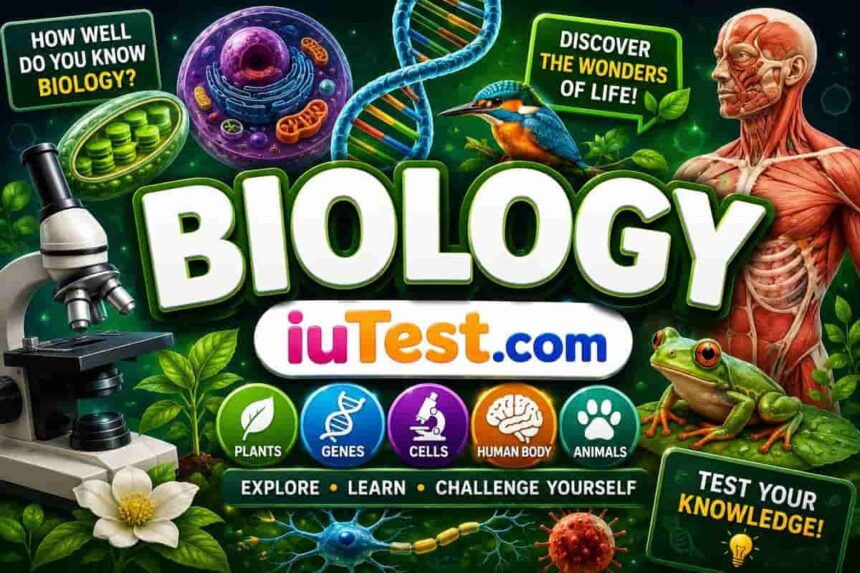
Biology is the study of life — and life, it turns out, is far stranger and more extraordinary than most people realize. From the molecular machinery inside a single cell to the complex interdependencies of entire ecosystems, biology reveals a world of breathtaking complexity operating at every scale.
This quiz draws 20 questions at random from a bank of thousands, covering cells, genetics, evolution, ecology, microbiology, and more. Log in and find out how deep your understanding of life science really goes.
- What Is Biology — and Why Does It Matter More Than Ever?
- 10 Biology Facts That Will Change How You See Life
- The Six Major Branches of Biology Covered in This Quiz
- Frequently Asked Questions
- How many questions are in this biology quiz?
- Is this quiz free?
- Is there a time limit?
- What topics does the biology quiz cover?
- What is a good score on this biology quiz?
- Can I retake the quiz?
- Is this quiz suitable for high school or university students?
- How is this quiz different from the Human Body Quiz on iutest.com?
The average score is 59%. Can you beat it?

| Pos. | Name | Score |
|---|---|---|
| There is no data yet |
What Is Biology — and Why Does It Matter More Than Ever?
Biology is the scientific study of living organisms — their structure, function, growth, evolution, distribution, and taxonomy. It is the broadest of all the natural sciences, encompassing everything from the behavior of subatomic particles in DNA to the dynamics of planetary ecosystems. Every other life science — medicine, ecology, genetics, microbiology, neuroscience, pharmacology — is a branch of biology.
Understanding biology has never been more important. The COVID-19 pandemic demonstrated in stark terms how biological knowledge — virology, immunology, epidemiology, vaccine development — determines the fate of entire civilizations. The climate crisis is fundamentally a biological crisis, as ecosystems that took millions of years to evolve are disrupted faster than they can adapt. CRISPR gene editing, artificial intelligence applied to protein folding, mRNA vaccine technology, personalized cancer medicine — the most consequential technologies of the 21st century are all biological.
And at the most personal level, biology is the science of you. Understanding how your cells work, how your genes are expressed, how your immune system functions, and how your brain generates consciousness — this is not abstract knowledge. It is self-knowledge of the deepest possible kind.
Nothing in biology makes sense except in the light of evolution.
Theodosius Dobzhansky
10 Biology Facts That Will Change How You See Life
The natural world is full of phenomena so extraordinary that they sound like science fiction. Every one of these facts is verified by peer-reviewed science.
- Every living thing on Earth shares the same genetic code. From bacteria to blue whales, the same four DNA bases (adenine, thymine, guanine, cytosine) encode the instructions for life using the same triplet codon system. This universal genetic code is one of the strongest pieces of evidence for the common ancestry of all life on Earth.
- A single gram of soil contains up to one billion bacteria. The microbial world is so vast that more bacteria exist in a handful of garden soil than there are stars in the observable universe. These microorganisms drive nutrient cycling, decomposition, and soil fertility — without them, terrestrial ecosystems would collapse within years.
- Mitochondria were once independent bacteria. According to the endosymbiotic theory — one of the most well-supported ideas in biology — mitochondria evolved from free-living bacteria that were engulfed by a larger cell approximately 1.5 billion years ago. Evidence includes the fact that mitochondria have their own DNA, divide independently of the cell, and have two membranes consistent with bacterial engulfment.
- Trees in forests communicate and share resources through underground fungal networks. Mycorrhizal fungi form networks connecting the roots of different trees, allowing them to share nutrients, water, and even chemical warning signals. A single tree can be connected to hundreds of others through this “wood wide web.” Mother trees — the oldest and largest in a forest — have been shown to preferentially route nutrients toward their own seedlings.
- The human immune system remembers every pathogen it has ever encountered. Adaptive immunity works by creating long-lived memory B and T cells after each infection. These cells can persist for decades — sometimes for life — enabling a faster and stronger immune response if the same pathogen is encountered again. This is the biological principle on which vaccination is based.
- Some organisms are essentially biologically immortal. The hydra — a tiny freshwater animal — shows no signs of aging and does not appear to die of old age. Its cells divide continuously to replace worn-out tissue, and it can regenerate its entire body from a fragment. The turritopsis dohrnii jellyfish can revert to its juvenile state after reaching maturity, restarting its life cycle indefinitely.
- The human genome contains approximately 20,000–25,000 protein-coding genes — fewer than a grain of rice. Rice (Oryza sativa) has between 40,000 and 60,000 genes, nearly twice as many as humans. The complexity of an organism is not determined by the number of genes it has, but by how those genes are regulated and expressed — a finding that profoundly changed our understanding of genetics after the Human Genome Project was completed in 2003.
- Viruses are not considered living organisms. Despite being capable of evolution and containing genetic material, viruses cannot reproduce independently, do not have cells, and do not carry out metabolism. They exist in a gray zone between living and non-living matter — infectious agents of extraordinary biological consequence that technically do not meet the criteria for life.
- CRISPR-Cas9 was discovered in bacteria as a natural immune system. The gene-editing technology that may cure genetic diseases was not invented — it was discovered in bacteria, which use CRISPR sequences as a molecular memory of past viral infections. Jennifer Doudna and Emmanuelle Charpentier recognized its potential as a precise gene-editing tool and shared the Nobel Prize in Chemistry in 2020.
- Approximately 99% of all species that have ever lived on Earth are now extinct. Life on Earth has existed for approximately 3.8 billion years. In that time, scientists estimate that between 5 and 50 billion species have existed — of which only approximately 8–10 million currently survive. Five major mass extinction events have occurred, the most recent of which wiped out the non-avian dinosaurs 66 million years ago.
The more clearly we can focus our attention on the wonders and realities of the universe about us, the less taste we shall have for destruction.
Rachel Carson
The Six Major Branches of Biology Covered in This Quiz
Biology is not a single discipline but a vast collection of related fields, each studying life at a different scale or through a different lens. This quiz draws questions from six major branches.
Cell biology studies the structure, function, and behavior of cells — the fundamental unit of life. Every living organism is composed of one or more cells, and all cells arise from pre-existing cells. Cell biology encompasses the study of organelles, the cell membrane, cell division, cellular respiration, and the molecular processes that keep cells alive.
Genetics is the study of heredity — how traits are passed from parents to offspring through genes. It encompasses classical Mendelian genetics (dominant and recessive inheritance), molecular genetics (DNA structure and function), and genomics (the study of entire genomes). Modern genetics underpins medicine, agriculture, forensic science, and evolutionary biology.
Evolution is the central organizing principle of all biology. The theory of evolution by natural selection, proposed by Charles Darwin and Alfred Russel Wallace in 1858, explains the diversity of life through the differential reproduction of organisms with heritable variations. Evolution is the framework that makes all other biological observations coherent.
Ecology studies the relationships between organisms and their environments — how populations interact, how energy flows through ecosystems, how matter is cycled, and how ecosystems respond to disturbance. Ecology is the foundation of conservation biology, environmental science, and our understanding of the living planet.
Microbiology is the study of microorganisms — bacteria, viruses, fungi, protozoa, and algae. Though invisible to the naked eye, these organisms drive most of the chemical processes that sustain life on Earth, cause most human diseases, and are the basis of biotechnology, food production, and wastewater treatment.
Anatomy and physiology study the structure and function of living organisms, particularly animals and humans. Anatomy describes what is there; physiology explains what it does. Together, they form the foundation of medicine and healthcare. For a quiz focused specifically on human anatomy, try our Human Body Quiz.
Frequently Asked Questions
How many questions are in this biology quiz?
Each round draws 20 questions at random from a bank of thousands, covering cells, genetics, evolution, ecology, microbiology, anatomy, and more. No two rounds are ever the same.
Is this quiz free?
Yes, completely free. You will need to create a free account to take the quiz and save your score to the leaderboard. Registration only takes a minute — no credit card required.
Is there a time limit?
Yes. Each question has a 10-second timer. For biology questions that require genuine recall, this keeps the challenge real and tests knowledge rather than the ability to search for answers.
What topics does the biology quiz cover?
The quiz covers cell biology, genetics and heredity, evolution and natural selection, ecology and ecosystems, microbiology, plant biology, animal biology, and human anatomy and physiology. Questions range from fundamental concepts to genuinely challenging details that will test even those with a strong biology background.
What is a good score on this biology quiz?
The average score is around 12 out of 20, or 59%. Scoring 15 or above puts you in the top 20% and reflects a strong foundation in life science. A perfect 20 out of 20 requires broad and deep biological knowledge — fewer than 3% of players achieve it.
Can I retake the quiz?
Yes, unlimited retakes. Because questions are drawn randomly from a large bank each time, every attempt covers a different selection of biology topics. Regular retakes are one of the most effective ways to identify gaps in your biological knowledge and track improvement over time.
Is this quiz suitable for high school or university students?
Yes. The quiz covers content appropriate for GCSE, A-Level, AP Biology, and introductory university biology courses. It works well as a revision tool before exams, a self-assessment tool, or a classroom activity. Teachers are welcome to share the link with students — no special setup required.
How is this quiz different from the Human Body Quiz on iutest.com?
The Human Body Quiz focuses specifically on human anatomy and physiology — organs, body systems, bones, and muscles. This Biology Quiz covers a much broader range of life science topics, including cell biology, genetics, evolution, and ecology, with human biology forming only one part of the content. For human anatomy specifically, try our Human Body Quiz.


