

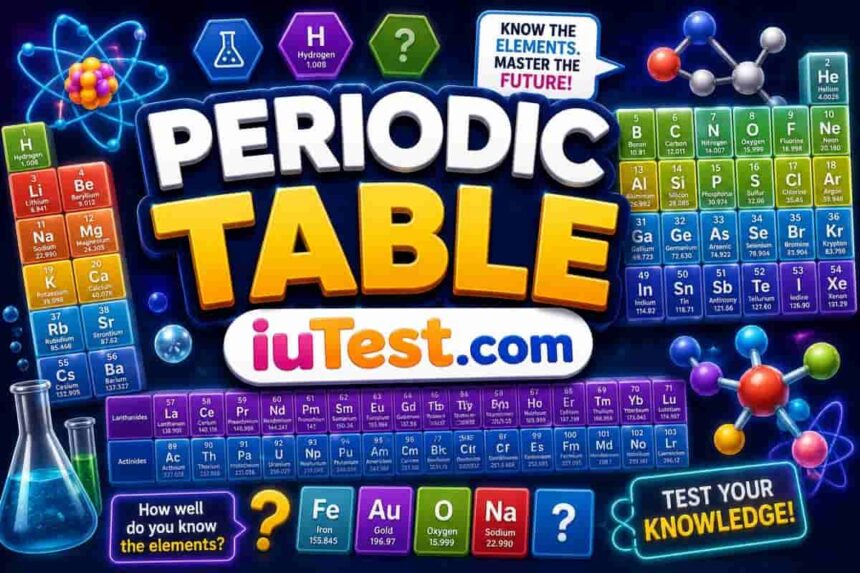
Most people can name ten elements. A chemistry teacher averages 94. A dedicated enthusiast might know all 118. Where do you land? This quiz draws 20 questions at random from a bank of thousands — covering element symbols, atomic numbers, element groups, and key properties. Log in and find out exactly where your chemistry knowledge stands.
The average score is 61%. Can you beat it?
- What Is the Periodic Table?
- The 10 Elements Most People Get Wrong
- How to Memorize the Periodic Table: Techniques That Actually Work
- Frequently Asked Questions
- How many questions are in this periodic table quiz?
- Is this quiz free?
- Is there a time limit?
- What topics does the periodic table quiz cover?
- What is a good score on this periodic table quiz?
- Can I retake the quiz?
- Is this quiz suitable for high school students?
- How does this quiz differ from other chemistry quizzes on iutest.com?

| Pos. | Name | Score |
|---|---|---|
| There is no data yet |
What Is the Periodic Table?
The periodic table is one of the most powerful organizing tools in the history of science — a single chart that arranges all 118 known chemical elements by atomic number, electron configuration, and recurring chemical properties. It allows chemists to predict how an element will behave before they have even tested it in a laboratory. No other tool in science compresses so much predictive power into such an elegant structure.
The table was first published by Russian chemist Dmitri Mendeleev in 1869. At the time, only 63 elements were known. Mendeleev arranged them by atomic mass and noticed a recurring pattern of properties — a periodicity — that allowed him to leave deliberate gaps for elements he predicted would be discovered in the future. He was right about every one of them. Within his own lifetime, three of his predicted elements — gallium, scandium, and germanium — were discovered and found to match his predictions almost exactly.
The modern periodic table organizes elements by atomic number rather than atomic mass, a refinement introduced by Henry Moseley in 1913. Elements are arranged in rows called periods and columns called groups. Elements in the same group share similar chemical behavior — the alkali metals in Group 1 are all highly reactive with water, the noble gases in Group 18 are all largely inert, and the halogens in Group 17 all form salts when combined with metals.
The most recently confirmed elements — nihonium (113), moscovium (115), tennessine (117), and oganesson (118) — were added to the table in 2016, completing the seventh period. All four are synthetic, meaning they do not occur naturally and can only be created briefly in particle accelerators before decaying within milliseconds.
The periodic table is one of the most elegant things in science — a simple chart that predicts the behavior of the entire physical universe.
Peter Atkins, Oxford chemist
The 10 Elements Most People Get Wrong
Some elements are deceptively tricky — their symbols bear no obvious relationship to their English names, their properties are counterintuitive, or they simply do not appear in everyday life. These are the ten that trip up even well-prepared quiz takers.
- Tungsten (W). The symbol W comes from “wolfram,” the German and Swedish name for the element. Only about 27% of people correctly identify W as tungsten on their first attempt. It has the highest melting point of any element at 3,422°C and is used in light bulb filaments and cutting tools.
- Iron (Fe). Fe comes from “ferrum,” the Latin word for iron. Iron is the fourth most abundant element in Earth’s crust and the most abundant element in Earth as a whole — the core is almost entirely iron and nickel.
- Gold (Au). Au comes from “aurum,” Latin for gold. Gold has been used in jewelry and currency for over 6,000 years and is one of the few elements found in nature in its pure metallic form.
- Mercury (Hg). Hg comes from “hydrargyrum,” the Latinized form of the Greek word for “water silver.” Mercury is the only metal that is liquid at room temperature and standard pressure.
- Lead (Pb). Pb comes from “plumbum,” the Latin word for lead — which is also the origin of the English word “plumbing,” as ancient Roman water pipes were made from lead.
- Sodium (Na). Na comes from “natrium,” the Latin word for sodium. Sodium is a soft, silvery-white metal so reactive that it must be stored in oil to prevent it from reacting explosively with moisture in the air.
- Potassium (K). K comes from “kalium,” the Latin word for potassium. Despite being essential to human health — regulating nerve function and muscle contraction — pure potassium metal reacts violently with water, catching fire spontaneously.
- Silver (Ag). Ag comes from “argentum,” the Latin word for silver. Argentina is named after this element — early Spanish explorers believed the region was rich in silver deposits.
- Tin (Sn). Sn comes from “stannum,” the Latin word for tin. Tin was one of the first metals smelted by humans and is the defining ingredient of bronze — an alloy of copper and tin that gave an entire age of human civilization its name.
- Antimony (Sb). Sb comes from “stibium,” an ancient Latin word. Antimony was known to the ancient Egyptians, who used its sulfide compound as a black eye cosmetic called kohl — making it one of the first elements ever intentionally processed by humans.
How to Memorize the Periodic Table: Techniques That Actually Work
Memorizing the periodic table is one of those tasks that sounds overwhelming until you have the right framework. Here are the approaches that chemistry students and competitive quiz players use to make it manageable.
Learn the groups, not the individual elements. Instead of memorizing 118 separate items, learn the eight main groups and their shared properties. Once you know that Group 1 elements are alkali metals that react violently with water, you automatically know something meaningful about lithium, sodium, potassium, rubidium, cesium, and francium — six elements from a single rule.
Prioritize the first 20 elements. Hydrogen to calcium are the most commonly tested elements in any chemistry quiz or exam. Memorize them in order — hydrogen, helium, lithium, beryllium, boron, carbon, nitrogen, oxygen, fluorine, neon, sodium, magnesium, aluminum, silicon, phosphorus, sulfur, chlorine, argon, potassium, calcium — and you will have answered the majority of symbol-based questions before you reach the transition metals.
Learn the Latin outliers as a separate list. The elements whose symbols do not match their English names are the most common source of quiz errors. There are only eleven of them: Fe, Cu, Ag, Au, Hg, Pb, Sn, Na, K, W, and Sb. Memorize these eleven as a group and they will never catch you off guard again.
Use mnemonics for periods and groups. For the first period of transition metals (Sc to Zn), try: “Silly Tina Visited Chris’s Manor, Feeding Cute Nibbling Cute Zebras.” Mnemonics are more memorable than raw lists because they create a narrative that gives the brain something to hold onto.
Retake this quiz regularly. Because questions are drawn randomly from a bank of thousands, every attempt covers a different selection of elements and properties. Most quiz takers see measurable score improvement within five attempts — not because the quiz gets easier, but because the gaps in their knowledge become visible and close.
In science, there are no shortcuts to truth.
Karl Popper
Frequently Asked Questions
How many questions are in this periodic table quiz?
Each round draws 20 questions at random from a bank of thousands, covering element symbols, atomic numbers, element groups, properties, and history. No two rounds are ever the same.
Is this quiz free?
Yes, completely free. You will need to create a free account to take the quiz and save your score to the leaderboard. Registration only takes a minute — no credit card required.
Is there a time limit?
Yes. Each question has a 10-second timer. For chemistry questions that require genuine recall, this keeps the pace challenging and tests knowledge rather than the ability to look things up.
What topics does the periodic table quiz cover?
The quiz covers element symbols and their origins, atomic numbers, element groups and their properties, states of matter at room temperature, melting and boiling points of notable elements, and the history of element discovery. It covers all 118 confirmed elements, with questions weighted toward the most commonly tested and most practically important ones.
What is a good score on this periodic table quiz?
The average score is around 12 out of 20, or 61%. Scoring 16 or above puts you in the top 20% of all players. A perfect score of 20 out of 20 requires deep knowledge of the full table — fewer than 3% of players achieve it.
Can I retake the quiz?
Yes, unlimited retakes. Because questions are drawn randomly from a large bank each time, every attempt tests a different selection of elements. Most players see significant score improvement within five attempts as they learn from their mistakes.
Is this quiz suitable for high school students?
Yes. The quiz is aligned with the chemistry content typically taught at GCSE, A-Level, and high school level in the US, UK, and Australia. It works well as a revision tool before exams. Teachers are welcome to share the link with students — no special setup required.
How does this quiz differ from other chemistry quizzes on iutest.com?
This quiz focuses specifically on the periodic table — element symbols, atomic numbers, groups, and properties. For a broader chemistry challenge covering atoms, bonds, and reactions, try our Chemistry Quiz.


