


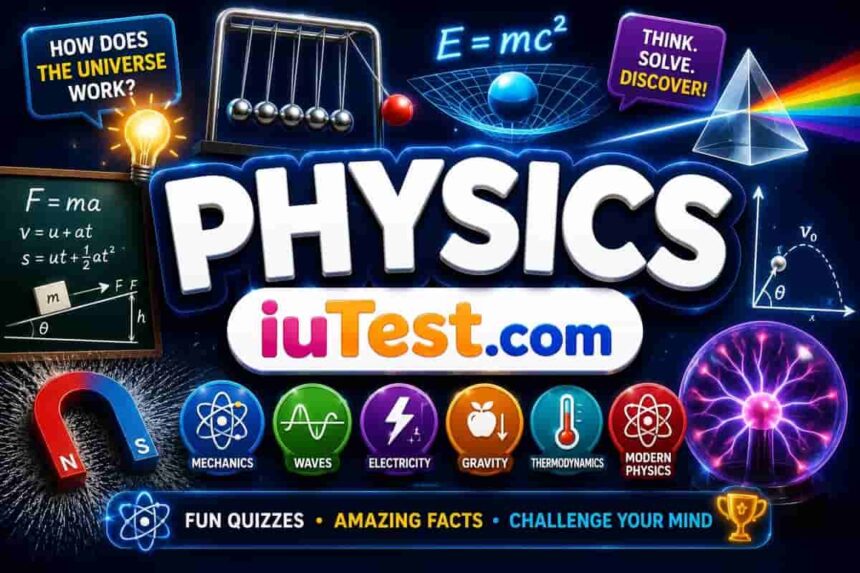
Physics is the science that explains why a dropped ball falls, why a plane stays in the air, why your phone’s GPS works, and why the universe itself began with a bang. It is the most fundamental of all sciences — every other field, from chemistry to biology to engineering, ultimately rests on physical laws.
This quiz draws 20 questions at random from a bank of thousands, covering forces, energy, motion, waves, and the principles that govern how everything in the universe behaves. Log in and find out how solid your physical intuition really is.
- Why Physics Is the Foundation of Everything
- 10 Physics Facts That Sound Wrong but Are Completely True
- The Core Branches of Physics Covered in This Quiz
- Frequently Asked Questions
- How many questions are in this physics quiz?
- Is this quiz free?
- Is there a time limit?
- What topics does the physics quiz cover?
- What is a good score on this physics quiz?
- Can I retake the quiz?
- Is this quiz suitable for high school or A-Level students?
- How is this different from the Space Quiz on iutest.com?
The average score is 56%. Can you beat it?

| Pos. | Name | Score |
|---|---|---|
| There is no data yet |
Why Physics Is the Foundation of Everything
There is a reason physics is sometimes called the “fundamental science.” Chemistry is, at its core, the physics of how atoms interact. Biology is built on the chemistry of molecules, which is built on physics. Engineering is applied physics. Even economics borrows physics concepts like equilibrium and momentum to describe how markets behave. If you trace any scientific question back far enough, you eventually arrive at physics.
What makes physics remarkable is not just its explanatory power but its predictive precision. When NASA calculates the trajectory of a spacecraft traveling to Mars, it is applying equations developed by Isaac Newton over 300 years ago, with corrections from Einstein’s relativity developed over a century ago — and the spacecraft lands within meters of its target after a journey of hundreds of millions of kilometers. When engineers design a bridge, a smartphone, or a power plant, they are relying on the same handful of physical principles that govern the motion of planets and the behavior of subatomic particles.
This predictive power is what separates physics from mere description. A physicist does not just observe that objects fall — they can tell you exactly how fast an object will be falling after exactly three seconds, on Earth or on the Moon, before you ever drop it. This quiz tests your understanding of the principles that make this kind of precise prediction possible.
Physics is not about how things are. It is about what we can say about nature.
Niels Bohr
10 Physics Facts That Sound Wrong but Are Completely True
Physics is full of counterintuitive truths — ideas that contradict everyday experience but are nonetheless rigorously proven. Here are ten of the most surprising.
- A feather and a hammer fall at the same rate in a vacuum. This was famously demonstrated on the Moon during the Apollo 15 mission in 1971, when astronaut David Scott dropped a feather and a hammer simultaneously — they hit the lunar surface at exactly the same time, confirming Galileo’s centuries-old prediction that gravitational acceleration is independent of mass.
- You are constantly falling toward the center of the Earth — you just never get there. Standing still on the ground, you are being pulled by gravity at all times. The normal force from the ground beneath your feet is what prevents you from actually falling. Remove the ground, and gravity would do the rest immediately.
- Time moves slower the faster you travel. This is a direct consequence of Einstein’s special relativity, confirmed experimentally using atomic clocks on airplanes. GPS satellites must constantly correct for this effect — without the correction, GPS positioning would drift by several kilometers per day.
- Nothing is actually touching anything else. What feels like solid contact between two objects is actually electromagnetic repulsion between the electron clouds of their atoms. At the atomic level, true physical “touching” in the everyday sense does not occur — objects repel each other before their particles ever make contact.
- Sound travels faster through solids than through air. Sound moves at approximately 343 meters per second through air, but through steel it travels at approximately 5,960 meters per second — over 17 times faster. This is because sound propagates through the vibration of particles, and particles in solids are packed much more tightly together than in gases.
- A ball thrown upward and a ball dropped from the same height at the same moment will not hit the ground at the same time — but a ball thrown horizontally and one dropped simultaneously will. Horizontal motion and vertical motion are entirely independent of one another. A bullet fired perfectly horizontally and a bullet simply dropped from the same height will hit the ground at exactly the same instant, regardless of the fired bullet’s forward speed.
- You can hear the past, but you can only see the very recent past. Light travels so fast (300,000 km/s) that for everyday distances, what you see is essentially instantaneous. But sunlight takes about 8 minutes to reach Earth — meaning you are always seeing the Sun as it was 8 minutes ago, not as it is right now.
- A spinning object resists changes to its orientation — this is why bicycles stay upright. This phenomenon, called gyroscopic precession, explains why a spinning bicycle wheel is much harder to tip over than a stationary one. The same principle keeps spinning tops upright and is used to stabilize satellites and spacecraft.
- The coldest possible temperature, absolute zero, can never actually be reached. Absolute zero (-273.15°C or 0 Kelvin) represents the complete absence of thermal energy. The third law of thermodynamics states that it is physically impossible to reach this temperature exactly, though scientists have cooled matter to within a fraction of a degree of it in laboratory conditions.
- Quantum particles can exist in two places at once — until you look at them. This is the famous principle of superposition in quantum mechanics, demonstrated repeatedly in laboratory experiments. A particle’s properties remain genuinely undetermined until a measurement is made, at which point it “collapses” into a single definite state — one of the strangest and most well-tested phenomena in all of science.
If you think you understand quantum mechanics, you don’t understand quantum mechanics.
Richard Feynman
The Core Branches of Physics Covered in This Quiz
Physics is traditionally divided into several major branches, each focusing on a different aspect of how the universe behaves. This quiz draws from the four most foundational branches.
Mechanics is the study of motion and the forces that cause it. It includes kinematics (describing motion using quantities like velocity and acceleration) and dynamics (explaining motion using forces, following Newton’s three laws of motion). Mechanics is the oldest and most intuitive branch of physics, forming the foundation of engineering, ballistics, and orbital science.
Thermodynamics studies heat, energy, and the transformation between them. Its four laws govern everything from how engines work to why a hot cup of coffee eventually cools to room temperature. The second law of thermodynamics — that entropy in a closed system always increases — is one of the most fundamental and unbreakable rules in all of physics.
Electromagnetism studies electric and magnetic forces, which are actually two aspects of the same fundamental force. This branch explains everything from why magnets attract metal to how light itself works, since light is an electromagnetic wave. James Clerk Maxwell’s equations, formulated in the 1860s, elegantly unified electricity, magnetism, and optics into a single theoretical framework.
Waves and optics study the behavior of waves — including sound, light, and water waves — and how they propagate, reflect, refract, and interfere with one another. This branch explains phenomena ranging from rainbows and mirages to the function of lenses, fiber optic cables, and musical instruments.
Frequently Asked Questions
How many questions are in this physics quiz?
Each round draws 20 questions at random from a bank of thousands, covering mechanics, thermodynamics, electromagnetism, waves, and modern physics. No two rounds are ever the same.
Is this quiz free?
Yes, completely free. You will need to create a free account to take the quiz and save your score to the leaderboard. Registration only takes a minute — no credit card required.
Is there a time limit?
Yes. Each question has a 10-second timer. For physics questions that require genuine understanding, this keeps the challenge real and tests conceptual knowledge rather than the ability to calculate at length.
What topics does the physics quiz cover?
The quiz covers classical mechanics (forces, motion, energy), thermodynamics, electromagnetism, waves and optics, and introductory modern physics concepts including relativity and quantum mechanics. Questions range from foundational principles to genuinely challenging concepts that will test even strong physics students.
What is a good score on this physics quiz?
The average score is around 11 out of 20, or 56%. Scoring 15 or above puts you in the top 20% and reflects a strong grasp of physical principles. A perfect 20 out of 20 requires broad knowledge across all major branches of physics — fewer than 3% of players achieve it.
Can I retake the quiz?
Yes, unlimited retakes. Because questions are drawn randomly from a large bank each time, every attempt covers a different selection of physics topics. Regular retakes are one of the most effective ways to identify gaps in your physics knowledge and build genuine understanding over time.
Is this quiz suitable for high school or A-Level students?
Yes. The quiz covers content appropriate for GCSE, A-Level, and introductory university physics courses. It works well as a revision tool before exams, a self-assessment tool, or a classroom activity. Teachers are welcome to share the link with students — no special setup required.
How is this different from the Space Quiz on iutest.com?
The Space Quiz focuses specifically on astronomy and astrophysics — planets, stars, galaxies, and space exploration. This Physics Quiz covers broader physical principles including mechanics, thermodynamics, and electromagnetism that apply far beyond astronomy. For a quiz focused specifically on space and the cosmos, try our Space Quiz.


