



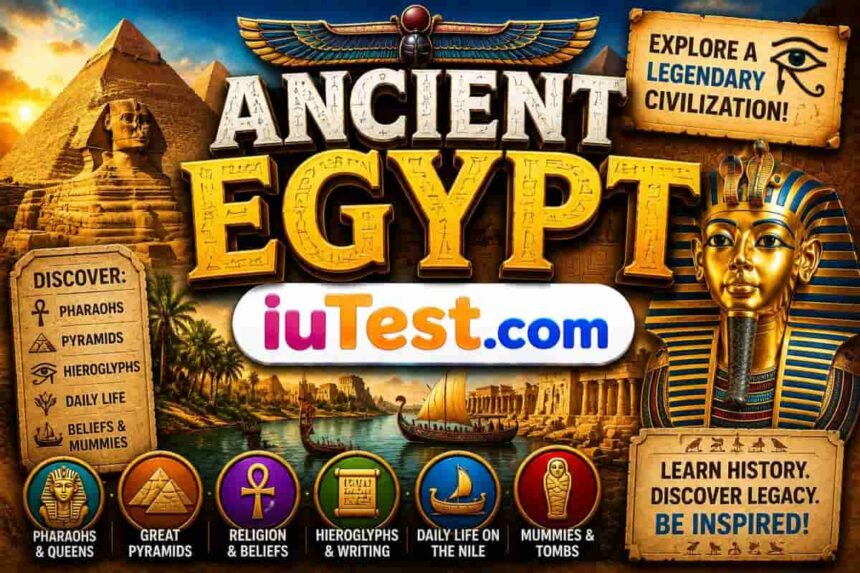
For over 3,000 years, ancient Egypt was one of the most sophisticated, powerful, and enduring civilizations the world has ever seen. Its pyramids still stand. Its hieroglyphs took centuries to decipher. Its gods are still recognizable by name.
And its mysteries — from the construction of the Great Pyramid to the identity of the Sphinx — still generate debate among historians and archaeologists today.
- Why Ancient Egypt Still Captivates the World
- 10 Ancient Egypt Facts That Will Genuinely Surprise You
- 1. Cleopatra lived closer in time to the Moon landing than to the building of the Great Pyramid.
- 2. The ancient Egyptians invented toothpaste.
- 3. Workers who built the pyramids were paid employees, not slaves.
- 4. Ancient Egyptians shaved their heads and wore wigs.
- 5. The ancient Egyptians kept detailed medical records describing over 200 diseases and conditions.
- 6. Egyptian women had remarkable legal rights for the ancient world.
- 7. The Sphinx’s nose was not broken off by Napoleon’s cannons.
- 8. Ancient Egyptians loved board games.
- 9. The ancient Egyptians used contraception.
- 10. Egypt was eventually conquered and ruled by foreign dynasties for the last centuries of its ancient history.
- A Guide to the Major Periods of Ancient Egyptian History
- Frequently Asked Questions
This quiz draws 20 questions at random from a bank of thousands, covering pharaohs, gods, monuments, daily life, and the legacy of one of history’s greatest civilizations. Log in and find out how much you really know about ancient Egypt.
The average score is 12 out of 20. Can you beat it?



| Pos. | Name | Score |
|---|---|---|
| There is no data yet |
Why Ancient Egypt Still Captivates the World
No ancient civilization exercises a more powerful hold on the modern imagination than Egypt. Partly this is a matter of scale — the Great Pyramid of Giza, built around 2560 BC, was the tallest structure on Earth for 3,800 years, and its construction still raises questions that engineers and archaeologists have not fully resolved.
Partly it is a matter of duration — ancient Egyptian civilization lasted over 3,000 years, longer than the span of time from ancient Rome to the present day. And partly it is a matter of preservation — the dry desert climate of Egypt has conserved physical remains that would have rotted or crumbled anywhere else on Earth, giving us an unusually intimate window into a world that existed millennia ago.
But beyond the monuments, what makes ancient Egypt endlessly fascinating is the complexity and sophistication of the civilization behind them. The Egyptians developed one of the world’s first writing systems.
They performed surgical procedures described in medical texts that remained the most advanced in the Western world for over a thousand years. They developed sophisticated astronomical knowledge that allowed them to align massive architectural structures with remarkable precision.
They created a legal system, a civil service, a school system, and a form of proto-banking — all at a time when much of the rest of the world was still organized in small farming communities.
This quiz explores all of it — from the construction of the pyramids to the religious beliefs that governed every aspect of Egyptian life, from the military conquests of the New Kingdom pharaohs to the eventually fall of the civilization that had endured for three millennia.
Egypt is the gift of the Nile.
Herodotus
10 Ancient Egypt Facts That Will Genuinely Surprise You
Ancient Egypt is one of those subjects where the reality turns out to be stranger and more impressive than the popular myths. Here are ten facts that consistently surprise people, even those who think they know Egyptian history well.
1. Cleopatra lived closer in time to the Moon landing than to the building of the Great Pyramid.
The Great Pyramid was completed around 2560 BC. Cleopatra was born in 69 BC — 2,491 years later. The Moon landing was in 1969 AD — 2,038 years after Cleopatra.
Ancient Egypt’s timeline is so vast that Cleopatra is closer to us than to the civilization’s own origins.
2. The ancient Egyptians invented toothpaste.
The earliest known dental cream recipe dates to around 4 AD in Egypt, containing rock salt, mint, dried iris flower, and pepper. Earlier Egyptian medical texts also reference dental treatments and tools remarkably similar to those used by ancient dentists.
3. Workers who built the pyramids were paid employees, not slaves.
Archaeological evidence, including workers’ villages, payroll records, and medical facilities near the Giza plateau, confirms that pyramid builders were skilled and semi-skilled workers paid in bread, beer, and commodities.
The slave-labor myth was popularized by Herodotus but is not supported by modern evidence.
4. Ancient Egyptians shaved their heads and wore wigs.
Both men and women frequently shaved their heads for cleanliness and wore elaborate wigs made from human hair or plant fibers. Wigs were status symbols — the more elaborate and well-maintained, the higher the wearer’s social standing.
5. The ancient Egyptians kept detailed medical records describing over 200 diseases and conditions.
The Ebers Papyrus (c. 1550 BC) and the Edwin Smith Papyrus (c. 1600 BC) describe surgical procedures, diagnostic methods, and treatments that demonstrate a sophisticated empirical approach to medicine far ahead of their contemporaries.
6. Egyptian women had remarkable legal rights for the ancient world.
Egyptian women could own property, conduct business, initiate divorce, inherit equally with men, and testify in court — rights that women in many Western societies would not achieve until the 20th century AD.
7. The Sphinx’s nose was not broken off by Napoleon’s cannons.
This popular story is false. Drawings made before Napoleon’s 1798 Egyptian campaign already show the Sphinx without its nose. A 15th-century Arab historian recorded that a religious fanatic named Muhammad Sa’im al-Dahr defaced the monument because local peasants made offerings to it.
8. Ancient Egyptians loved board games.
Senet, one of the oldest known board games in the world, was played in Egypt as far back as 3500 BC. It was so popular that pharaohs were buried with Senet sets, and it appears in tomb paintings across multiple dynasties.
9. The ancient Egyptians used contraception.
Egyptian medical texts describe contraceptive methods including pessaries made from acacia gum, dates, and honey. Acacia gum contains arabinogalactan, which has demonstrated actual spermicidal properties in laboratory testing — suggesting these ancient recipes may have had genuine effectiveness.
10. Egypt was eventually conquered and ruled by foreign dynasties for the last centuries of its ancient history.
After the New Kingdom period, Egypt was successively ruled by Libyans, Nubians, Assyrians, Persians, Greeks (under Alexander the Great and the Ptolemaic dynasty), and finally Romans.
Cleopatra, the last pharaoh, was actually Greek — a member of the Macedonian Greek Ptolemaic dynasty — and may have been the first member of that dynasty to actually speak Egyptian.
To speak the name of the dead is to make him live again.
Ancient Egyptian proverb
A Guide to the Major Periods of Ancient Egyptian History
Ancient Egyptian history spans over 3,000 years and is divided by historians into distinct periods. Understanding this framework makes every Egyptian history question significantly easier.
The Early Dynastic Period (c. 3100–2686 BC) began with the unification of Upper and Lower Egypt under the first pharaoh, traditionally identified as Narmer or Menes. Writing, centralized government, and monumental architecture all emerged during this formative era.
The Old Kingdom (c. 2686–2181 BC), often called the “Age of the Pyramids,” saw the construction of the most iconic Egyptian monuments, including the Step Pyramid of Djoser, the Great Pyramid of Khufu, and the Sphinx. The pharaoh was considered a divine being, and the enormous resources of the state were directed toward preparing royal tombs of unmatched scale.
The Middle Kingdom (c. 2055–1650 BC) was a period of political reunification and cultural flowering after a period of fragmentation. Literature, art, and trade flourished, and the pharaoh was increasingly portrayed as a shepherd of his people rather than a remote divine figure.
The New Kingdom (c. 1550–1070 BC) was Egypt’s imperial age — the era of its greatest military power and territorial expansion. Pharaohs including Thutmose III, Ramesses II, and Hatshepsut built vast temples and fought campaigns across the ancient Near East. This was also the era of Tutankhamun, whose intact tomb, discovered in 1922, transformed public fascination with ancient Egypt.
The Late Period (c. 664–332 BC) saw Egypt ruled by a succession of foreign dynasties — Libyan, Nubian, Assyrian, and Persian — before Alexander the Great’s conquest in 332 BC, which ushered in the Hellenistic Ptolemaic dynasty that would produce Cleopatra and ultimately end with Roman conquest in 30 BC.
Frequently Asked Questions
How many questions are in this ancient Egypt quiz?
Each round draws 20 questions at random from a bank of thousands, covering pharaohs, monuments, gods, hieroglyphs, daily life, military history, and Egypt’s place in the ancient world. No two rounds are ever the same.
Is this quiz free?
Yes, completely free. You will need to create a free account to take the quiz and save your score to the leaderboard. Registration only takes a minute — no credit card required.
Is there a time limit?
Yes. Each question has a 10-second timer. History questions reward genuine recall, so the timer is designed to test solid knowledge rather than guessing.
What topics does the ancient Egypt quiz cover?
The quiz covers the major pharaohs and dynasties, Egyptian gods and religious beliefs, monuments including the pyramids and the Sphinx, hieroglyphs and the decipherment of Egyptian writing, daily life in ancient Egypt, military history and foreign relations, and the eventual decline and end of ancient Egyptian civilization.
What is a good score on this quiz?
The average score is around 12 out of 20, or 60%. Scoring 16 or above puts you in the top 20% and reflects strong knowledge of ancient Egyptian history.
A perfect 20 out of 20 requires broad knowledge across all major periods and aspects of Egyptian civilization.
Can I retake the quiz?
Yes, unlimited retakes. Because questions are drawn randomly from a large bank each time, every attempt covers a different selection of Egyptian history topics.
Regular retakes are an excellent way to build a more complete picture of this extraordinary civilization.
Is this quiz suitable for school students?
Yes. The quiz covers content appropriate for primary and secondary school history curricula.
Ancient Egypt is a standard topic in schools across the UK, US, and Australia, and this quiz works well as a classroom activity, a revision tool, or an independent study supplement.
How does this quiz differ from other history quizzes on iutest.com?
This quiz focuses specifically on ancient Egypt. For questions covering other ancient civilizations including ancient Greece and Rome, try our Ancient Greece and Rome Quiz.
For broader world history including more recent periods, try our World War 2 Quiz.