


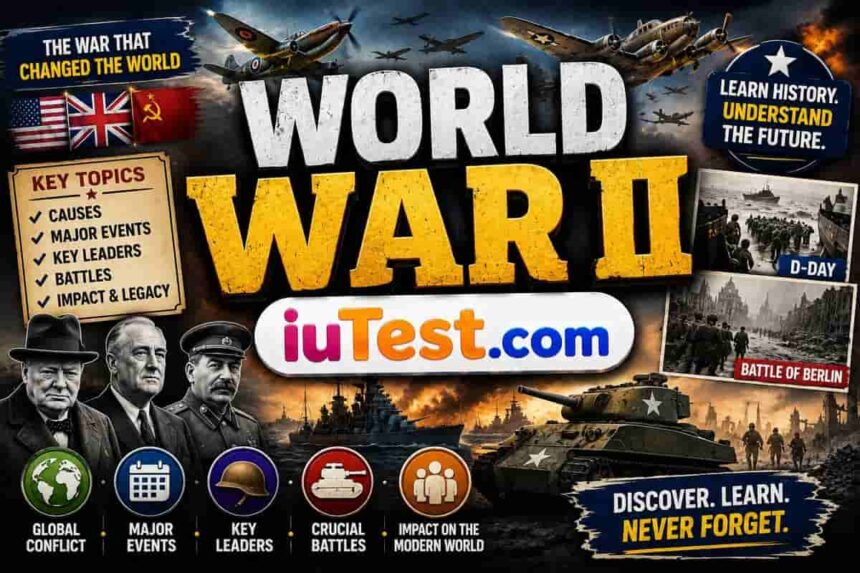
World War 2 was the deadliest conflict in human history — six years of war that reshaped every continent, ended empires, created superpowers, and left a legacy that still defines the world we live in today.
This quiz draws 20 questions at random from a bank of thousands, covering key battles, political leaders, turning points, and the human stories behind the history. Log in and find out how much you really know about the war that changed everything.
- Why World War 2 Remains the Most Important Event of the 20th Century
- 10 World War 2 Facts That Reveal the True Scale of the Conflict
- The Key Turning Points of World War 2
- Frequently Asked Questions
- How many questions are in this World War 2 quiz?
- Is this quiz free?
- Is there a time limit?
- What topics does the World War 2 quiz cover?
- What is a good score on this quiz?
- Can I retake the quiz?
- Is this quiz suitable for school students?
- Does the quiz cover the Pacific theater as well as the European theater?
The average score is 12 out of 20. Can you beat it?

| Pos. | Name | Score |
|---|---|---|
| There is no data yet |
Why World War 2 Remains the Most Important Event of the 20th Century
History is full of wars, but World War 2 occupies a unique position — not just in terms of its scale, which was unprecedented, but in terms of the permanence of its consequences.
Every major institution that governs the world today — the United Nations, NATO, the International Monetary Fund, the World Bank, the modern borders of Europe and Asia, the state of Israel, the nuclear arsenals of the world’s great powers — was either created by, shaped by, or is a direct response to World War 2.
To understand the world as it exists today, understanding World War 2 is not optional.
The war lasted from September 1, 1939, when Germany invaded Poland, to September 2, 1945, when Japan formally surrendered aboard the USS Missouri in Tokyo Bay.
In those six years, an estimated 70 to 85 million people died — approximately 3% of the world’s population at the time. Of these deaths, the majority were civilians, killed through bombing, famine, disease, occupation, and deliberate genocide, most horrifically in the Holocaust, in which six million Jewish people and millions of others were systematically murdered by the Nazi regime.
This quiz does not attempt to compress all of that history into 20 questions — that would be impossible. What it does is test the factual knowledge that forms the framework through which the rest of the history can be understood: the dates, the leaders, the battles, the alliances, the turning points, and the outcomes that determine why the world looks the way it does today.
Those who cannot remember the past are condemned to repeat it.
George Santayana
10 World War 2 Facts That Reveal the True Scale of the Conflict
The statistics of World War 2 are so extreme that they can feel abstract. Here are ten facts that help make that scale concrete.
The Soviet Union suffered more deaths than any other nation — an estimated 27 million people.
This figure is so vast it is difficult to comprehend: it represents nearly 14% of the Soviet population before the war. The Eastern Front, where Germany and the Soviet Union fought, was by far the largest and bloodiest theater of the entire war, accounting for more deaths than all other theaters combined.
The Battle of Stalingrad alone resulted in approximately 2 million casualties.
Fought from August 1942 to February 1943, the battle for the Soviet city of Stalingrad was arguably the single most decisive engagement of the war. Germany’s defeat there marked the turning point of the Eastern Front and effectively ended any realistic prospect of a German victory in the Soviet Union.
D-Day involved approximately 156,000 Allied troops crossing the English Channel in a single day.
The Normandy landings on June 6, 1944, were the largest seaborne invasion in history. The operation involved over 5,000 ships, 11,000 aircraft, and troops from the United States, the United Kingdom, Canada, France, and numerous other Allied nations.
The Holocaust killed an estimated 6 million Jewish people — approximately two thirds of European Jewry.
This systematic genocide was planned and executed by the Nazi regime through a network of concentration camps, extermination camps, and mass shootings across occupied Europe. It remains the most thoroughly documented genocide in human history.
Japan’s attack on Pearl Harbor killed 2,403 Americans and brought the United States into the war.
The surprise attack on the American naval base at Pearl Harbor, Hawaii, on December 7, 1941 — “a date which will live in infamy,” in President Roosevelt’s words — brought the world’s largest industrial economy fully into the war on the Allied side, fundamentally shifting its balance of power.
The Manhattan Project employed approximately 130,000 people and cost the equivalent of $23 billion in today’s money.
The secret American program to develop atomic weapons was the largest scientific and engineering project in history at the time. Its two products — the bombs dropped on Hiroshima and Nagasaki in August 1945 — killed an estimated 129,000 to 226,000 people and ended the war with Japan within days.
Germany invaded the Soviet Union with approximately 3 million soldiers — the largest land invasion in history.
Operation Barbarossa, launched on June 22, 1941, involved 3.8 million Axis troops crossing a front stretching 2,900 kilometers. Despite initial enormous successes, the invasion ultimately proved to be the strategic overreach that cost Germany the war.
The war at sea involved over 1,000 German U-boats, which sank approximately 3,500 Allied ships.
The Battle of the Atlantic — the campaign to control the sea lanes between North America and Britain — lasted the entire duration of the war and was the longest continuous military campaign of WW2. Of the approximately 40,000 German U-boat crew who served, 28,000 were killed — a casualty rate of 70%.
Women played an unprecedented role in World War 2 on both the battlefield and the home front.
Women served in combat roles in the Soviet military, flew military aircraft in the United States as WASP pilots, cracked codes at Bletchley Park, worked in munitions factories, led resistance networks in occupied Europe, and performed virtually every role previously reserved exclusively for men.
The war produced approximately 1,100 documented acts of resistance and sabotage across occupied Europe.
Underground resistance movements in France, Poland, Yugoslavia, Greece, Norway, and other occupied countries conducted intelligence operations, assassinations, sabotage of infrastructure, and rescue of persecuted minorities, often at enormous personal risk — with many resisters executed when captured.
In war, you can only be killed once, but in politics many times.
Winston Churchill
The Key Turning Points of World War 2
Understanding World War 2 is easier when viewed through its major turning points — the moments when the momentum of the war shifted decisively. This quiz draws questions from all of them.
The Fall of France (May–June 1940) shocked the world. Germany defeated France — then considered the world’s most powerful army — in just six weeks through a combination of armored warfare, air power, and outmaneuvering of French defensive strategy. Britain now stood alone against Germany in the West.
The Battle of Britain (July–October 1940) was Germany’s failed attempt to establish air superiority over Britain as a prelude to invasion. The Royal Air Force’s successful defense against the Luftwaffe denied Germany control of the skies and forced Hitler to abandon his invasion plans — the first major German defeat of the war.
Operation Barbarossa (June 1941) opened the Eastern Front, the largest theater of war in history. Germany’s invasion of the Soviet Union, despite initial enormous gains, ultimately overextended German forces, drew them into a war of attrition they could not win, and created the alliance with the Soviet Union that would ultimately defeat Nazi Germany.
Pearl Harbor (December 1941) brought the United States into the war, shifting its industrial and military weight decisively to the Allied side. American involvement transformed the war’s economic balance beyond any possibility of German or Japanese recovery.
Stalingrad (1942–1943) marked the high-water mark of German advance into the Soviet Union. The destruction of the German 6th Army there was the largest defeat in German military history and the beginning of a Soviet advance that would not stop until Berlin fell in May 1945.
D-Day (June 1944) opened a second major front in Western Europe, stretching German resources to breaking point and beginning the liberation of Western Europe that ended with Germany’s unconditional surrender in May 1945.
Frequently Asked Questions
How many questions are in this World War 2 quiz?
Each round draws 20 questions at random from a bank of thousands, covering the causes of the war, key battles and campaigns, political and military leaders, the Holocaust, the home front, and the war’s aftermath. No two rounds are ever the same.
Is this quiz free?
Yes, completely free. You will need to create a free account to take the quiz and save your score to the leaderboard. Registration only takes a minute — no credit card required.
Is there a time limit?
Yes. Each question has a 10-second timer. History questions require genuine recall, so the timer rewards solid knowledge over guessing.
What topics does the World War 2 quiz cover?
The quiz covers the causes and outbreak of the war, major battles and campaigns in Europe, North Africa, and the Pacific, key political and military leaders on all sides, the Holocaust and war crimes, the home front, significant dates and turning points, and the end of the war and its aftermath.
What is a good score on this quiz?
The average score is around 12 out of 20, or 60%. Scoring 16 or above puts you in the top 20% and reflects strong knowledge of WW2 history. A perfect 20 out of 20 requires broad and detailed knowledge across all theaters of the war.
Can I retake the quiz?
Yes, unlimited retakes. Because questions are drawn randomly from a large bank each time, every attempt covers a different selection of WW2 topics. Regular retakes are an excellent way to discover the gaps in your WW2 knowledge and build a more complete picture of the conflict over time.
Is this quiz suitable for school students?
Yes. The quiz covers content appropriate for secondary school and high school history curricula in the US, UK, and Australia. It works well as a classroom activity, a homework revision tool, or an independent study supplement. Teachers are welcome to share the link — no special setup required.
Does the quiz cover the Pacific theater as well as the European theater?
Yes. The quiz draws questions from both the European and Pacific theaters of the war, as well as the North African campaign and the Eastern Front. Questions are weighted to reflect the historical significance of each theater, with additional coverage of the major turning points and key leaders on all sides.