




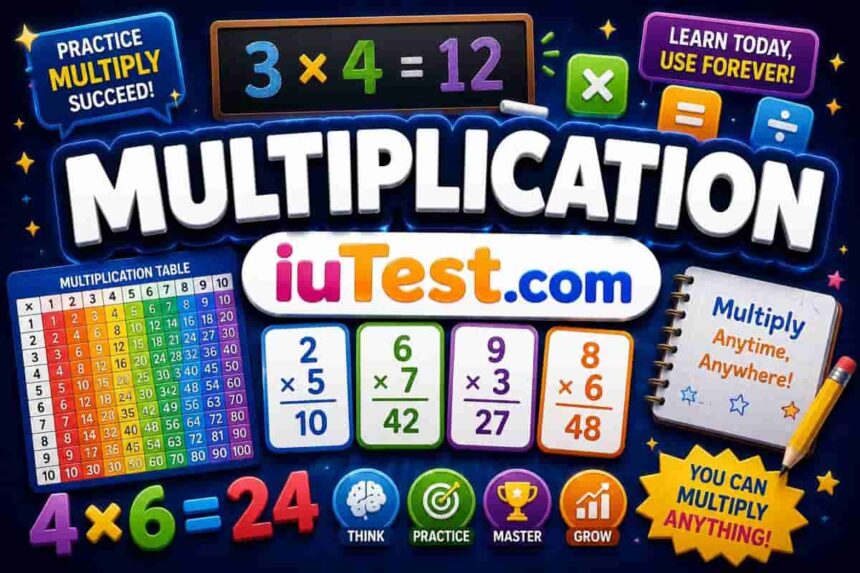
Multiplication tables are one of the few pieces of math that, once memorized, stay with you for life.
This quiz draws 20 questions at random from a bank of thousands, testing how quickly and accurately you can recall your times tables — from the easy ones everyone knows to the trickier combinations that even adults sometimes hesitate on.
- Why Times Tables Still Matter in the Calculator Age
- 10 Multiplication Facts and Patterns That Make Times Tables Click
- 1 – The 9 times table has a built-in checking trick.
- 2 – You only need to truly memorize half the table.
- 3 – The 5 times table always ends in 0 or 5.
- 4 – Squares (a number times itself) follow a visual diagonal pattern on a times table chart.
- 5 – The 11 times table has an elegant shortcut for two-digit numbers.
- 6 – Doubling and halving can simplify tricky multiplications.
- 7 – The 6 times table mirrors the 3 times table, doubled.
- 8 – Multiplying by 10 is just adding a zero — but multiplying by 9 is almost as simple.
- 9 – The hardest facts for most students are the same handful every time.
- 10 – Times tables were considered essential schooling over 4,000 years ago.
- How to Practice Times Tables Effectively
- Frequently Asked Questions
Log in and find out how fast you really are. The average score is 14 out of 20. Can you beat it?

| Pos. | Name | Score |
|---|---|---|
| 1 |  Michelle M Michelle M | 100 % |
| 2 |  Laura M. Laura M. | 40 % |
Why Times Tables Still Matter in the Calculator Age
Every few years, someone asks why children still memorize multiplication tables when every phone has a calculator built in. It is a fair question on the surface — but it misunderstands what memorizing times tables actually accomplishes.


Multiplication facts are not memorized so that you never need to multiply numbers larger than 12 — those genuinely do require a calculator or written working. They are memorized because instant recall of basic multiplication frees up mental capacity for harder problems.
A student who has to pause and calculate 7 × 8 from scratch every time it appears inside a larger algebra problem is spending precious working memory on something that should be automatic, leaving less mental bandwidth for the actual problem-solving the larger task requires.
This is the same reason why fluent readers do not sound out every word letter by letter — automaticity in foundational skills is what makes advanced skills possible. Cognitive scientists call this concept “cognitive load.”
The less mental effort a basic skill requires, the more capacity remains available for complex thinking. This is precisely why times table fluency continues to correlate strongly with later success in algebra, geometry, and beyond, even in a world full of calculators.
Mathematics is not about numbers, equations, computations, or algorithms: it is about understanding.
William Paul Thurston
10 Multiplication Facts and Patterns That Make Times Tables Click
The times tables are full of hidden patterns that, once noticed, make memorization dramatically easier. Here are ten that work for nearly every student.
1 – The 9 times table has a built-in checking trick.
For any single-digit number multiplied by 9, the digits of the answer always add up to 9. Check it: 9 × 4 = 36, and 3+6=9. 9 × 7 = 63, and 6+3=9. This pattern holds for every single-digit multiple of 9.
2 – You only need to truly memorize half the table.
Because multiplication is commutative (6 × 8 equals 8 × 6), once you know one combination, you automatically know its reverse. This effectively cuts the memorization workload of a 12×12 times table grid roughly in half.
3 – The 5 times table always ends in 0 or 5.
Every multiple of 5 follows this rule without exception, making the 5 times table one of the easiest to recognize at a glance, even without calculating.
4 – Squares (a number times itself) follow a visual diagonal pattern on a times table chart.
If you write out a full multiplication grid, the square numbers (1, 4, 9, 16, 25, 36…) form a perfectly straight diagonal line from corner to corner — a pattern that makes squares easier to memorize as a connected group rather than isolated facts.
5 – The 11 times table has an elegant shortcut for two-digit numbers.
To multiply any two-digit number by 11, add the two digits together and insert that sum between the original digits. For 11 × 45: add 4+5=9, then insert it between 4 and 5, giving 495.
6 – Doubling and halving can simplify tricky multiplications.
To calculate 16 × 5, you can halve 16 to get 8, then double 5 to get 10, giving the same answer (80) through an easier calculation: 8 × 10.
7 – The 6 times table mirrors the 3 times table, doubled.
Since 6 is simply 3 × 2, every answer in the 6 times table is exactly double the corresponding answer in the 3 times table. Knowing your 3s makes your 6s almost automatic.
8 – Multiplying by 10 is just adding a zero — but multiplying by 9 is almost as simple.
To multiply any number by 9, multiply it by 10 first, then subtract the original number once. For 9 × 23: 10 × 23 = 230, then 230 − 23 = 207.
9 – The hardest facts for most students are the same handful every time.
Educational research consistently shows that 6×7, 6×8, 7×8, and 8×9 are the multiplication facts students most commonly struggle to recall instantly — likely because they fall in the “middle zone” of the table, away from the easier patterns of the 1s, 2s, 5s, 10s, and squares.
10 – Times tables were considered essential schooling over 4,000 years ago.
Archaeological evidence shows that Babylonian students were memorizing multiplication tables on clay tablets as early as 1800 BC — making times table practice one of the oldest continuously taught skills in human education.
The only way to learn mathematics is to do mathematics.
Paul Halmos
How to Practice Times Tables Effectively
Not all practice methods are equally effective. Here is what actually works, based on how memory formation functions.
Practice in short, frequent bursts rather than long sessions.
Five minutes of focused practice every day produces dramatically better long-term retention than one 30-minute session per week. This phenomenon, known as “spaced repetition,” is one of the most well-established findings in cognitive psychology.
Focus extra time on your weak facts, not your strong ones.
Most students already know their 1s, 2s, 5s, and 10s cold. Practice time is far better spent on the genuinely difficult combinations — typically in the 6, 7, and 8 times tables — rather than repeating facts that are already automatic.
Use the timer feature on this quiz as a benchmark.
Take the quiz once without worrying about speed to identify which facts you hesitate on. Then retake it regularly, watching both your accuracy and your overall completion time improve as those weak facts become automatic.
Connect new facts to ones you already know.
If you know 5 × 6 = 30, you are only one step away from knowing 6 × 6 = 36 (just add another 6). Building new facts from known ones is far more effective than memorizing each fact as an isolated, disconnected piece of information.
Frequently Asked Questions
How many questions are in this multiplication quiz?
Each round draws 20 questions at random from a bank of thousands, covering the full range of times tables from 1 through 12. No two rounds are ever the same.
Is this quiz free?
Yes, completely free. You will need to create a free account to take the quiz and save your score to the leaderboard. Registration only takes a minute — no credit card required.
Is there a time limit?
Yes. Each question has a 10-second timer. This encourages instant recall rather than slow calculation, which is the entire point of times table practice.
What times tables does this quiz cover?
The quiz covers multiplication facts from the 1 times table through the 12 times table, with questions weighted to include extra coverage of the combinations students find most difficult, such as 6, 7, and 8 times tables.
What is a good score on this quiz?
The average score is around 14 out of 20, or 70%. Scoring 18 or above puts you in the top 20% and reflects strong times table fluency. A perfect 20 out of 20 under the 10-second timer reflects genuine automatic recall.
Can I retake the quiz?
Yes, unlimited retakes. Because questions are drawn randomly from a large bank each time, every attempt presents a fresh combination of facts. Regular retakes are one of the most effective ways to build true times table automaticity over time.
Is this quiz suitable for children?
Yes. This quiz is specifically designed to be accessible for children learning their times tables, typically from around age 7 through middle school, while still being a worthwhile speed challenge for adults brushing up on their mental math.
Can this quiz be used in schools or for homeschooling?
Absolutely. The multiplication quiz works excellently as a daily timed warm-up, a homework supplement, or a homeschool curriculum addition. Teachers and parents are welcome to share the link with students — no special setup required.

