

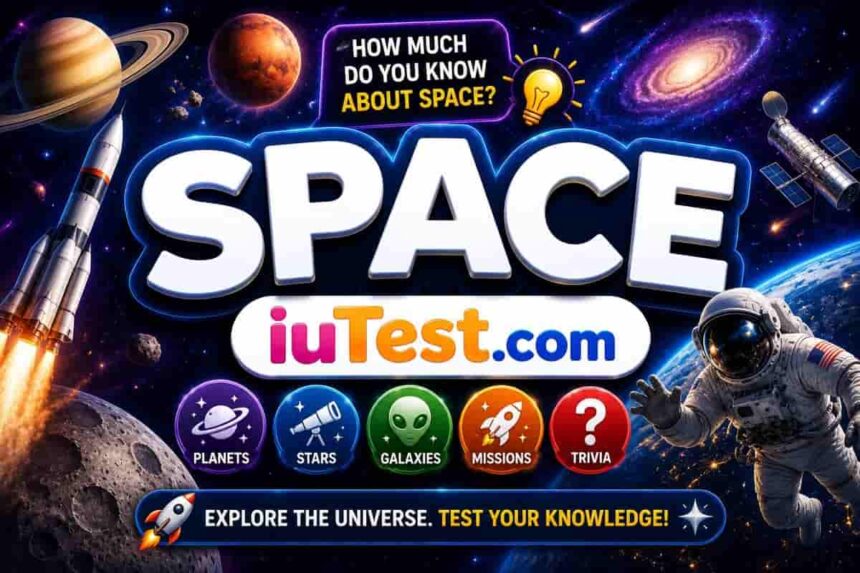
The observable universe contains an estimated two trillion galaxies, each with hundreds of billions of stars. Light from the most distant objects we can see has been traveling for over 13 billion years to reach us — meaning we are looking at the universe as it existed almost back to the beginning of time itself.
This quiz draws 20 questions at random from a bank of thousands, covering planets, stars, galaxies, space exploration, and the physics that governs it all. Log in and find out how much of the universe you actually understand.
The average score is 57%. Can you beat it?

| Pos. | Name | Score |
|---|---|---|
| There is no data yet |
Why Space Makes Everything Else Feel Small
There is a particular kind of vertigo that comes from thinking seriously about space — astronomers and psychologists call it the “overview effect,” first described by astronauts who experienced a profound shift in perspective after seeing Earth from orbit. But you do not need to leave the planet to feel a version of it. You just need the right numbers.
Consider this: if the Sun were the size of a basketball, Earth would be the size of a peppercorn, orbiting about 24 meters away. On that same scale, the nearest star beyond our solar system, Proxima Centauri, would be another basketball located approximately 6,400 kilometers away — roughly the distance from New York to London. Our entire solar system, which already feels unimaginably vast, is a rounding error compared to the space between stars.
Zoom out further and it gets stranger. Our Sun is one of an estimated 100–400 billion stars in the Milky Way galaxy. The Milky Way itself is one of an estimated two trillion galaxies in the observable universe. And the observable universe — the part we can actually see, limited by the speed of light and the age of the universe — may be just a tiny fraction of a much larger, possibly infinite cosmos that we will never be able to observe.
This quiz cannot capture the full scale of the universe — nothing really can. But it can test how well you understand the structures, mechanics, and discoveries that astronomers have used to map this almost incomprehensible vastness.
Somewhere, something incredible is waiting to be known.
Carl Sagan
10 Space Facts That Sound Impossible — but Are Completely Real
Space science is full of facts so extreme they sound like science fiction. Every one of these is grounded in verified astronomical observation and physics.
- A day on Venus is longer than a year on Venus. Venus takes 243 Earth days to complete one rotation but only 225 Earth days to orbit the Sun. Additionally, Venus rotates in the opposite direction to most planets — meaning the Sun rises in the west and sets in the east.
- Neutron stars are so dense that a teaspoon of their material would weigh about a billion tons. Neutron stars form when massive stars collapse under their own gravity after a supernova. The resulting object packs roughly the mass of the Sun into a sphere only about 20 kilometers across, creating densities that defy ordinary intuition.
- There is a planet made largely of diamond. 55 Cancri e, an exoplanet roughly twice the size of Earth, is theorized to have a carbon-rich composition that, under the planet’s extreme pressure, could form vast quantities of diamond within its interior.
- The footprints on the Moon will likely last millions of years. The Moon has no atmosphere, no wind, and no liquid water — the forces that erode footprints on Earth simply do not exist there. The footprints left by Apollo astronauts in 1969 are expected to remain essentially undisturbed for millions of years, barring micrometeorite impacts.
- It rains diamonds on Jupiter and Saturn. Scientists believe that lightning storms in the atmospheres of Jupiter and Saturn convert methane into soot, which compresses into graphite and eventually diamond as it falls through the immense atmospheric pressure, before melting into liquid carbon deeper in the planet’s interior.
- The largest known star could fit over 1,000 Suns inside it — if it had a defined surface. UY Scuti, a hypergiant star, has an estimated radius roughly 1,700 times that of the Sun. If placed at the center of our solar system, its surface would extend beyond the orbit of Jupiter.
- Space is completely silent. Sound requires a medium — air, water, or solid material — to travel through, propagating as pressure waves. The vacuum of space contains essentially no matter to carry sound waves, meaning that explosions, collisions, and other dramatic events in space are, contrary to almost every science fiction film, completely silent.
- One million Earths could fit inside the Sun. The Sun has a diameter of approximately 1.39 million kilometers, compared to Earth’s 12,742 kilometers. Despite its enormous size, the Sun is considered an average-sized star — many stars in the universe are far larger.
- There is a strong possibility that more habitable planets exist than there are grains of sand on every beach on Earth. With an estimated 100–400 billion stars in the Milky Way alone, and recent exoplanet research suggesting that most stars host at least one planet, the number of potentially habitable worlds across the observable universe’s two trillion galaxies is almost certainly larger than the estimated 7.5 quintillion grains of sand on Earth.
- Astronauts grow taller in space. Without the constant compressive force of Earth’s gravity on the spine, astronauts can temporarily grow up to 3% taller during extended missions — sometimes gaining several centimeters in height. The effect reverses within weeks of returning to Earth’s gravity.
The universe is under no obligation to make sense to you.
Neil deGrasse Tyson
A Tour of the Solar System: What Makes Each Planet Unique
Before you take the quiz, here is a quick tour of the eight planets — the foundation that most space quiz questions are built on.
Mercury, the closest planet to the Sun, has almost no atmosphere to trap heat, leading to extreme temperature swings — from 430°C during the day to minus 180°C at night. A year on Mercury lasts just 88 Earth days, making it the fastest-orbiting planet in the solar system.
Venus, often called Earth’s twin due to its similar size, is actually the hottest planet in the solar system, with surface temperatures around 465°C caused by a runaway greenhouse effect from its thick carbon dioxide atmosphere — hotter even than Mercury, despite being farther from the Sun.
Earth remains the only known planet to support life, owing to its precise distance from the Sun, protective magnetic field, liquid water, and oxygen-rich atmosphere — a combination of factors astronomers call the “habitable zone” and “Goldilocks conditions.”
Mars, the Red Planet, gets its color from iron oxide (rust) covering its surface. It is home to Olympus Mons, the largest known volcano in the solar system, standing nearly three times the height of Mount Everest, and Valles Marineris, a canyon system that would stretch across the entire continental United States.
Jupiter is the largest planet in the solar system — so massive that it has more mass than all the other planets combined. Its Great Red Spot is a storm larger than Earth that has been raging for at least 150 years and possibly much longer.
Saturn is famous for its stunning ring system, composed of ice and rock particles ranging from tiny grains to chunks the size of a house. Despite its size, Saturn is the least dense planet in the solar system — it would actually float in water if a body of water large enough existed.
Uranus rotates on its side, with an axial tilt of 98 degrees — likely the result of a massive collision early in its history. This extreme tilt means each pole experiences 42 years of continuous sunlight followed by 42 years of darkness.
Neptune, the farthest planet from the Sun, has the strongest winds in the solar system, reaching speeds of up to 2,100 kilometers per hour. It takes approximately 165 Earth years to complete a single orbit — meaning it has only completed one full orbit since its discovery in 1846.
Frequently Asked Questions
How many questions are in this space quiz?
Each round draws 20 questions at random from a bank of thousands, covering planets, stars, galaxies, space exploration, and astrophysics. No two rounds are ever the same.
Is this quiz free?
Yes, completely free. You will need to create a free account to take the quiz and save your score to the leaderboard. Registration only takes a minute — no credit card required.
Is there a time limit?
Yes. Each question has a 10-second timer. For space questions that require genuine recall, this keeps the challenge real and tests knowledge rather than the ability to look things up.
What topics does the space quiz cover?
The quiz covers our solar system and its planets, stars and stellar evolution, galaxies, space exploration history, astrophysics concepts, and notable astronomers and discoveries. Questions range from foundational facts to genuinely challenging details that will test even dedicated space enthusiasts.
What is a good score on this space quiz?
The average score is around 11 out of 20, or 57%. Scoring 15 or above puts you in the top 20% and reflects strong astronomical knowledge. A perfect 20 out of 20 requires deep familiarity with both the solar system and broader astrophysics — fewer than 3% of players achieve it.
Can I retake the quiz?
Yes, unlimited retakes. Because questions are drawn randomly from a large bank each time, every attempt covers a different selection of space topics. Regular retakes are a great way to build genuine astronomy knowledge over time.
Is this quiz suitable for school students?
Yes. The quiz covers content appropriate for primary, secondary, and introductory university-level astronomy and physics courses. It works well as a classroom activity, a homework revision tool, or a science club challenge. Teachers are welcome to share the link with students — no special setup required.
How is this different from the Physics Quiz on iutest.com?
The Physics Quiz covers general physics concepts including forces, energy, and motion. This Space Quiz focuses specifically on astronomy and astrophysics — planets, stars, galaxies, and space exploration. For broader physics concepts, try our Physics Quiz.


