


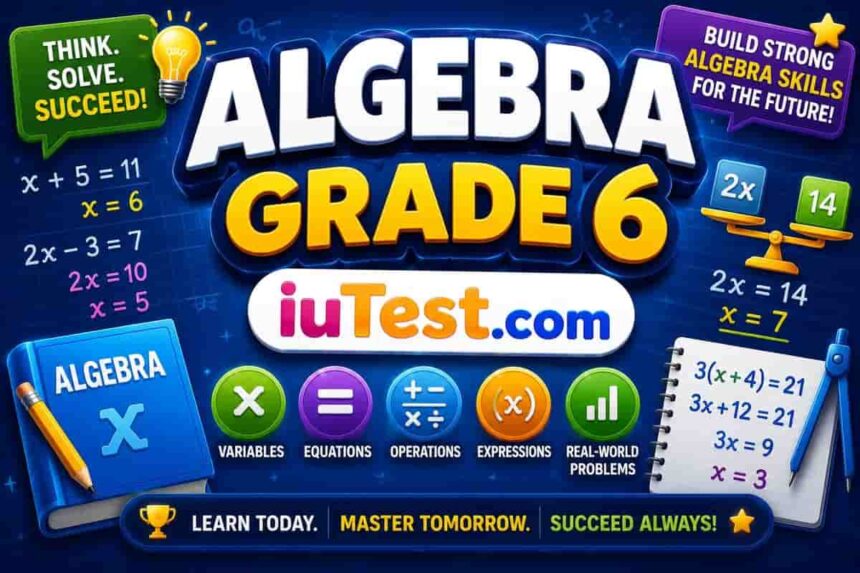
Algebra is the moment mathematics stops being just about numbers and starts being about relationships between numbers — and for most students, Grade 6 is exactly when that shift happens.
Variables, expressions, equations, and simple problem-solving replace straightforward arithmetic, and the whole landscape of mathematics opens up into something broader and more powerful.
This quiz draws 20 questions at random from a bank of thousands, covering all the core algebraic concepts introduced at Grade 6 level. Log in and find out how ready you are.
The average score is 12 out of 20. Can you beat it?



| Pos. | Name | Score |
|---|---|---|
| 1 |  Laura M. Laura M. | 25 % |
What Is Algebra — and Why Does It Matter?
Algebra is, at its core, the mathematics of unknown quantities. Where arithmetic asks “what is 3 + 4?”, algebra asks “if x + 4 = 7, what is x?”
This shift from working with known numbers to reasoning about unknowns is the foundation of virtually all higher mathematics, as well as the quantitative reasoning used in physics, economics, engineering, computer science, and countless other fields.
The word “algebra” comes from the title of a 9th-century mathematical treatise written by the Persian mathematician Muhammad ibn Musa al-Khwarizmi — “Al-Kitab al-mukhtasar fi hisab al-jabr wal-muqabala,” meaning “The Compendious Book on Calculation by Completion and Balancing.”
The word “al-jabr” in this title, meaning “completion” or “restoring,” gave us the word algebra. Al-Khwarizmi is also the origin of the word “algorithm” — his Latinized name, Algoritmi, became the term for any systematic mathematical procedure.
At Grade 6 level, algebra introduces students to the most fundamental tools of this discipline: variables as representations of unknown quantities, expressions as mathematical phrases built from variables and numbers, and equations as mathematical sentences asserting that two expressions are equal.
Solving an equation — finding the value of the unknown that makes the equation true — is the central skill that all subsequent algebra builds upon.
Algebra is the intellectual instrument which has been created for rendering clear the quantitative aspects of the world.
Alfred North Whitehead
10 Algebra Concepts Every Grade 6 Student Should Understand
These ten concepts form the foundation of Grade 6 algebra. Understanding them genuinely — not just memorizing procedures — makes every subsequent level of mathematics significantly more manageable.
A variable is not a mystery — it is a placeholder.
The letter x (or n, or any letter) in an algebraic expression is simply a placeholder for a number that is either unknown or that can change. There is nothing magical about it. 3x just means “3 times whatever number x represents.”
An expression is not the same as an equation.
An expression like 2x + 5 is a mathematical phrase — it has value, but it makes no claim about equality. An equation like 2x + 5 = 11 is a mathematical sentence asserting that the expression equals a specific value. You can simplify an expression, but you solve an equation.
The equals sign means “is the same as,” not “here comes the answer.”
Many students internalize the equals sign as a signal to write the answer, rather than as a statement of equality. This misunderstanding creates problems in algebra, where equations must be kept balanced — any operation performed on one side must be performed on the other.
Solving an equation means isolating the variable.
To solve 2x + 5 = 11, the goal is to get x alone on one side of the equation. This is done by performing inverse operations — subtraction undoes addition, division undoes multiplication — on both sides simultaneously, keeping the equation balanced throughout.
Order of operations applies inside algebraic expressions.
When substituting a value for a variable and evaluating an expression, the same order of operations rules apply: parentheses first, then exponents, then multiplication and division, then addition and subtraction — remembered through PEMDAS or BODMAS.
Like terms can be combined; unlike terms cannot.
In the expression 3x + 2y + 5x, the terms 3x and 5x are “like terms” because they both contain the variable x — they can be combined to give 8x. The term 2y cannot be combined with them because it contains a different variable. This simplification step is fundamental to all algebraic manipulation.
The distributive property is one of the most important algebraic tools.
It states that a(b + c) = ab + ac, meaning you can distribute multiplication across addition. This property is the basis for expanding brackets and is used constantly in algebra, geometry, and beyond.
A negative number multiplied by a negative number always gives a positive result.
This rule frequently appears in algebra when solving equations that involve negative values. Understanding why this is true — rather than just memorizing it — significantly reduces errors in algebraic calculations.
Algebra is about patterns as much as it is about solving equations.
Recognizing that the sequence 3, 7, 11, 15… increases by 4 each time, and can be expressed as 4n − 1 for the nth term, is algebraic thinking even when no equation is being solved. Pattern recognition and generalization are at the heart of algebraic reasoning.
Checking your answer by substituting back into the original equation is always worth doing.
After solving for x, substitute the value back into the original equation. If both sides balance, the answer is correct. This habit catches errors immediately and builds confidence — and it only takes a few seconds.
Algebra is generous; she often gives more than is asked of her.
Jean le Rond d’Alembert
What Grade 6 Algebra Covers — Topic by Topic
Grade 6 algebra typically covers four main topic areas, each of which is represented in this quiz.
Variables and expressions introduce the concept of using letters to represent unknown or changing quantities. Students learn to write algebraic expressions from word descriptions, evaluate expressions by substituting given values for variables, and simplify expressions by combining like terms.
Equations and inequalities introduce the concept of mathematical sentences that assert relationships between expressions. Students learn to determine whether a given value satisfies an equation or inequality, and to solve one-step and two-step equations using inverse operations.
Ratios and proportions extend fraction thinking into algebraic contexts, asking students to identify and extend proportional relationships, solve proportion problems, and connect ratio reasoning to real-world contexts such as scaling, unit pricing, and speed calculations.
Introduction to functions and patterns asks students to describe, extend, and generalize number patterns using algebraic notation, and introduces the concept of a function as a rule that assigns exactly one output to each input — the foundational idea that underpins all of advanced algebra, calculus, and mathematical modeling.
Frequently Asked Questions
How many questions are in this Grade 6 algebra quiz?
Each round draws 20 questions at random from a bank of thousands, covering variables, expressions, one-step and two-step equations, inequalities, and basic pattern recognition. No two rounds are ever the same.
Is this quiz free?
Yes, completely free. You will need to create a free account to take the quiz and save your score to the leaderboard. Registration only takes a minute — no credit card required.
Is there a time limit?
Yes. Each question has a 10-second timer. Algebra questions require slightly more reasoning than basic arithmetic, so the timer is set to encourage careful but confident thinking.
What algebra topics does this quiz cover?
The quiz covers variables and expressions, evaluating expressions, solving one-step and two-step equations, simple inequalities, ratio and proportion, and basic pattern recognition — all topics typically covered in Grade 6 mathematics curricula in the US, UK, and Australia.
What is a good score on this quiz?
The average score is around 12 out of 20, or 60%. Scoring 16 or above puts you in the top 20% and reflects strong Grade 6 algebra understanding. A perfect 20 out of 20 requires genuine mastery across all four topic areas.
Can I retake the quiz?
Yes, unlimited retakes. Because questions are drawn randomly from a large bank each time, every attempt presents a fresh set of algebra problems. Regular retakes are one of the most effective ways to identify which specific algebra topics need more practice.
Is this quiz suitable for Grade 6 students?
Yes. This quiz is designed specifically for Grade 6 students studying algebra for the first time, as well as for older students who want to review foundational algebraic concepts. It works well as a homework supplement, a pre-test review tool, or a classroom warm-up activity.
Can this quiz be used by teachers or for homeschooling?
Absolutely. The Grade 6 algebra quiz aligns with standard middle school mathematics curricula and works well as a classroom assessment tool, a differentiated learning resource, or a homeschool curriculum supplement. Teachers and parents are welcome to share the link with students — no special setup required.

