



Fractions are, for many students, the first genuinely difficult topic in mathematics — the moment when math stops being just bigger numbers and starts requiring a different kind of thinking entirely.
This quiz draws 20 questions at random from a bank of thousands, testing your ability to simplify, add, subtract, multiply, and compare fractions.
Log in and find out whether fractions are still tripping you up, or whether you have genuinely mastered them. The average score is 12 out of 20. Can you beat it?

| Pos. | Name | Score |
|---|---|---|
| 1 |  Laura M. Laura M. | 25 % |
Why Fractions Are Genuinely Harder Than Whole Number Math
It is not your imagination, and it is not a personal failing: fractions really are a cognitively different kind of challenge than whole number arithmetic, and education researchers have spent decades studying exactly why.


Multiple academic studies of mathematics achievement have consistently identified fractions as one of the strongest predictors of later success in algebra — stronger even than whole number arithmetic skills — yet they remain one of the topics students struggle with most.
Part of the difficulty is conceptual. With whole numbers, “bigger digit means bigger number” is a rule that works reliably — 8 is always more than 5. With fractions, that intuition actively betrays you: 1/8 is smaller than 1/5, even though 8 is the bigger number.
Students who have spent years building solid intuitions about whole numbers suddenly find those same intuitions working against them, which is precisely why fractions feel so disorienting when first introduced.
The other source of difficulty is that fractions require holding two numbers in relationship to each other simultaneously — the numerator and denominator are not independent values but a description of a relationship, a part compared to a whole.
This relational thinking is a genuinely more sophisticated cognitive skill than counting or basic arithmetic, which is exactly why mastering fractions tends to mark a meaningful developmental milestone in a student’s mathematical thinking.
Do not worry about your difficulties in mathematics. I can assure you mine are still greater.
Albert Einstein
10 Fraction Facts and Concepts That Make Everything Click
Here are ten ideas about fractions that, once genuinely understood, tend to dissolve most of the confusion students experience.
A fraction is just an unfinished division problem.
The fraction 3/4 literally means “3 divided by 4.” This single reframe explains why 1/2 equals 0.5 — because 1 divided by 2 is 0.5 — and demystifies the entire relationship between fractions and decimals.
You can multiply or divide both the numerator and denominator by the same number without changing the fraction’s value.
This is the single most important rule in all of fraction arithmetic. It is why 1/2, 2/4, 3/6, and 50/100 are all exactly the same value, just written differently — and it is the rule that makes simplifying and finding common denominators possible at all.
To add or subtract fractions, they must share a common denominator.
This is not an arbitrary rule — it reflects a real conceptual requirement. You cannot meaningfully add “1 out of 3 parts” to “1 out of 4 parts” without first converting them to describe parts of the same size whole, just as you cannot add 3 apples and 4 oranges and call the answer “7 apples.”
Multiplying fractions is actually easier than adding them.
Many students find this surprising, since multiplication usually feels harder. But to multiply fractions, you simply multiply the numerators together and the denominators together — no common denominator required. 2/3 × 3/4 = 6/12, which simplifies to 1/2.
Dividing by a fraction is the same as multiplying by its reciprocal.
This rule — “keep, change, flip” — converts every division problem into an easier multiplication problem. Dividing by 1/2 is mathematically identical to multiplying by 2, which is why dividing something by a fraction smaller than 1 always produces a larger result, a fact that often confuses students at first.
An improper fraction (where the numerator is larger than the denominator) is not a mistake — it is just an unconverted mixed number.
7/4 and 1¾ represent exactly the same value, just expressed differently. Improper fractions are often easier to perform calculations with, even though mixed numbers are easier to intuitively understand.
Ancient Egyptians almost exclusively used “unit fractions” — fractions with a numerator of 1.
Rather than writing 3/4, Egyptian mathematicians would express it as the sum of unit fractions like 1/2 + 1/4. This system, while cumbersome by modern standards, was used successfully for complex engineering calculations, including those behind the construction of the pyramids.
A fraction’s value does not change no matter how large the numbers in it become — as long as the ratio stays the same.
1/2 and 5,000,000/10,000,000 represent exactly the same quantity. This is genuinely counterintuitive for many students, who instinctively feel that bigger numbers should somehow represent a bigger value.
Recurring decimals always represent a fraction, even when the digits never seem to end.
The decimal 0.333333… (repeating forever) is exactly equal to 1/3 — not an approximation, but a precise, exact equivalence. This is one of the clearest demonstrations of how fractions and decimals describe the exact same underlying mathematical reality, just in different notations.
Comparing fractions becomes effortless once you cross-multiply.
To compare 3/5 and 5/8 without finding a common denominator, simply cross-multiply: 3 × 8 = 24, and 5 × 5 = 25. Since 25 is greater than 24, 5/8 is the larger fraction — a shortcut that works every time and avoids the extra step of finding a shared denominator.
In mathematics, you don’t understand things. You just get used to them.
John von Neumann
The Five Core Fraction Skills This Quiz Tests
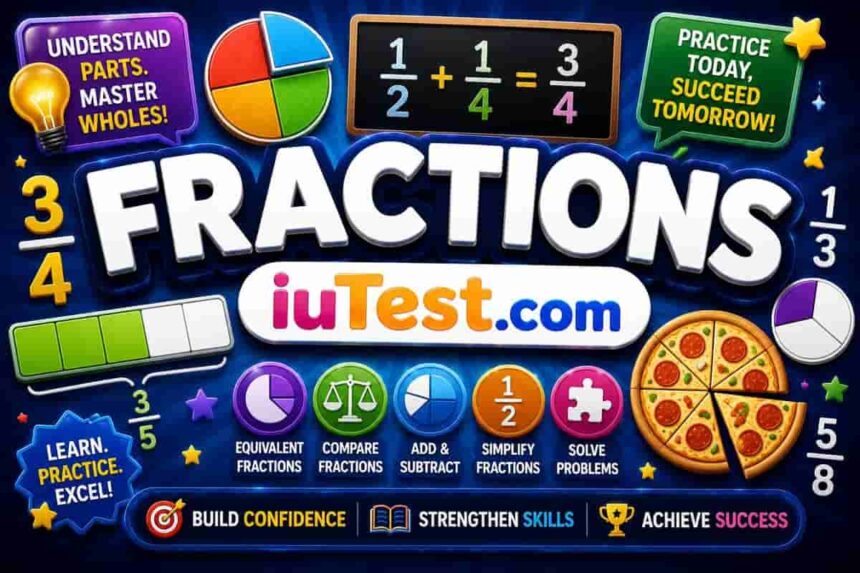
This quiz draws from five fundamental fraction skills, each building on the one before it.
Simplifying fractions means reducing a fraction to its lowest terms by dividing both the numerator and denominator by their greatest common factor. 8/12 simplifies to 2/3 by dividing both numbers by 4.
This is typically the very first fraction skill taught, since it builds the foundational understanding that different-looking fractions can represent the same value.
Comparing fractions requires determining which of two fractions represents a larger or smaller value, either by finding a common denominator or by cross-multiplying.
This skill is essential for ordering fractions and for understanding fraction magnitude intuitively, rather than relying purely on memorized rules.
Adding and subtracting fractions requires a shared denominator before the numerators can be combined.
Students must first find the least common denominator, convert each fraction accordingly, then perform the addition or subtraction on the numerators alone, leaving the denominator unchanged.
Multiplying fractions is computationally the most straightforward operation — multiply the numerators together, multiply the denominators together, then simplify the result if possible.
No common denominator is required for multiplication, which often surprises students who expect every fraction operation to require the same setup.
Converting between fractions, decimals, and mixed numbers requires understanding that all three are simply different notations for expressing the same underlying values.
Fluency in converting between these forms is essential for real-world applications, from cooking measurements to financial calculations.
Frequently Asked Questions
How many questions are in this fractions quiz?
Each round draws 20 questions at random from a bank of thousands, covering simplifying, comparing, adding, subtracting, and multiplying fractions, as well as converting between fractions and decimals. No two rounds are ever the same.
Is this quiz free?
Yes, completely free. You will need to create a free account to take the quiz and save your score to the leaderboard. Registration only takes a minute — no credit card required.
Is there a time limit?
Yes. Each question has a 10-second timer. Fraction problems require slightly more thought than basic arithmetic, so the timer is designed to encourage steady, confident calculation rather than rushed guessing.
What level of fractions does this quiz cover?
The quiz covers fraction skills typically taught from upper elementary through middle school, including simplifying, comparing, adding, subtracting, multiplying, and converting fractions. It does not cover more advanced topics such as algebraic fractions or rational expressions.
What is a good score on this quiz?
The average score is around 12 out of 20, or 60%. Scoring 16 or above puts you in the top 20% and reflects genuinely strong fraction skills. A perfect 20 out of 20 requires solid mastery across all five core fraction operations.
Can I retake the quiz?
Yes, unlimited retakes. Because questions are drawn randomly from a large bank each time, every attempt presents a fresh set of fraction problems. Regular retakes are one of the most effective ways to identify which specific fraction skills need more practice.
Is this quiz suitable for children?
Yes. This quiz is designed to be accessible for upper elementary and middle school students learning fraction concepts, while still being a worthwhile refresher for adults who want to brush up on skills they may not have used since school.
Can this quiz be used in schools or for homeschooling?
Absolutely. The fractions quiz works excellently as a classroom warm-up, a homework supplement, or a homeschool curriculum addition. Teachers and parents are welcome to share the link with students — no special setup required.

