



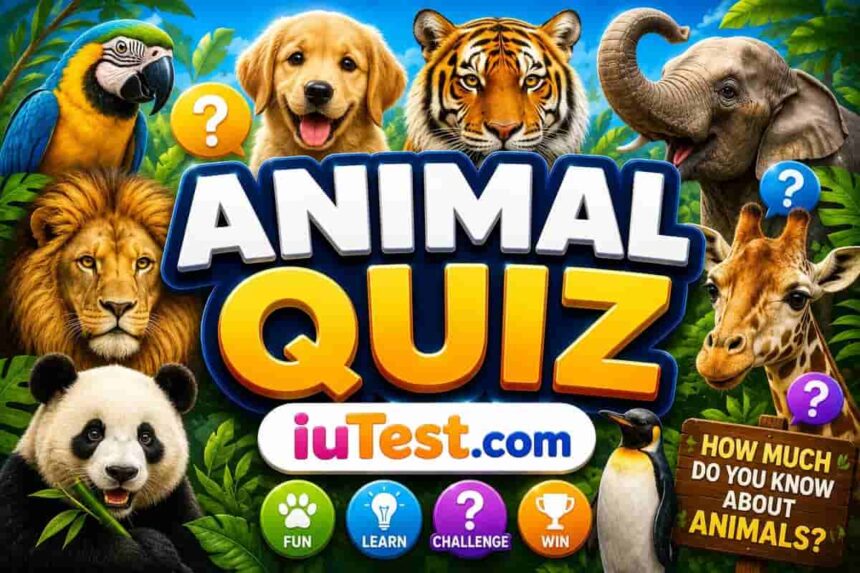
There are over 8 million species of animals on Earth. This quiz covers the most fascinating ones — from the fastest land animal to the deepest creature in the ocean, from the bird that cannot fly to the mammal that never stops growing its teeth. Twenty questions drawn at random from a bank of thousands, so every round is a completely fresh challenge.
Log in, take the quiz, and find out whether you really know the animal kingdom — or just think you do.

| Pos. | Name | Score |
|---|---|---|
| There is no data yet |
The Animal Kingdom Is Stranger Than You Think
Most people know that cheetahs are fast and elephants never forget. But the animal kingdom goes far beyond what appears in wildlife documentaries. The deeper you look, the stranger it gets — and the more impossible it becomes to stop reading.
Take the mantis shrimp. It has 16 types of color receptors in its eyes — humans have three. It can see colors we cannot even imagine, in a spectrum so far beyond human perception that scientists struggle to describe what the world must look like through its eyes. It can also punch with a force equivalent to a bullet from a .22 caliber pistol, fast enough to boil the water around its claw from the heat generated.
Or consider the axolotl — a salamander that never grows up. Most amphibians go through metamorphosis, losing their gills and moving onto land. The axolotl retains its larval form for its entire life, keeping its feathery external gills and remaining permanently aquatic. It can also regenerate entire limbs, parts of its heart, and sections of its brain — a capability that has made it one of the most studied animals in regenerative medicine.
These are the kinds of facts this quiz is built on. Not just what an animal is called, but what makes it extraordinary.
The question is not, can they reason? Nor, can they talk? But, can they suffer?
Jeremy Bentham
10 Animal Facts That Will Change How You See the Natural World
Before you take the quiz, here are ten facts about animals that most people — including dedicated wildlife enthusiasts — do not know. Every single one is scientifically verified.
- Crows can recognize human faces — and hold grudges. Research at the University of Washington showed that crows remember the faces of people who have threatened them, warn other crows about those individuals, and pass this information down to their offspring. A crow you upset today may have descendants that recognize your face decades from now.
- Octopuses have three hearts, blue blood, and nine brains. Two hearts pump blood to the gills, one pumps it to the body. Their blood is blue because it uses copper-based hemocyanin instead of iron-based hemoglobin. And each of their eight arms contains its own neural cluster that can act semi-independently — giving them, in effect, nine decision-making centers.
- A group of flamingos is called a flamboyance. The collective nouns for animal groups are extraordinarily imaginative: a parliament of owls, a murder of crows, a conspiracy of lemurs, a bloat of hippopotamuses, and an ambush of tigers.
- Elephants are the only animals that cannot jump. All other mammals, including hippos and rhinos, are physically capable of jumping — even if they very rarely do. The elephant’s leg structure and sheer weight make it anatomically impossible for all four feet to leave the ground simultaneously.
- Sea otters hold hands while sleeping. To prevent themselves from drifting apart in ocean currents, sea otters float on their backs and hold paws with other otters in their group — a behavior called “rafting.” They also wrap themselves in kelp to stay anchored to the sea floor.
- A shrimp’s heart is in its head. More precisely, it is located in the thorax, which in shrimp is fused with the head into a single region called the cephalothorax. The same is true of most crustaceans. Their circulatory systems are very different from those of vertebrates.
- Wombats produce cube-shaped droppings. They are the only animals in the world known to do this. The cubic shape helps the droppings stay in place as territorial markers rather than rolling away. Scientists only fully explained the biomechanics of how this occurs in a 2021 research paper.
- Butterflies taste with their feet. Butterflies have chemoreceptors — taste sensors — on their tarsi, the segmented feet at the end of their legs. When a butterfly lands on a plant, it can immediately sense whether the plant is suitable for laying eggs, long before bringing it close to its mouth.
- The immortal jellyfish can revert to its juvenile state. Turritopsis dohrnii — the so-called “immortal jellyfish” — is the only known animal that can revert to its sexually immature form after reaching maturity, effectively restarting its life cycle. Under stress or injury, it undergoes transdifferentiation, where its cells transform back into their earliest state. Biologically, it may never die of old age.
- A blue whale’s heart is the size of a small car. The heart of a blue whale weighs approximately 180 kilograms and is roughly the size of a Mini Cooper. Its aorta — the main artery — is wide enough for a human to crawl through. It beats just 8 to 10 times per minute when the whale dives deep.
Until one has loved an animal, a part of one’s soul remains unawakened.
Anatole France
Why the Animal Kingdom Is the Best Subject for a Quiz
Of all the topics that appear in trivia and general knowledge quizzes, animal questions consistently produce the strongest reactions — the most surprised gasps, the most disputed answers, and the most people who insist on looking things up afterward to verify what they just heard.
There are a few reasons for this. First, most people feel confident about animals. Everyone grew up learning about them, watching nature documentaries, and visiting zoos. This familiarity creates the perfect setup for a great trivia question — one where the answer is close enough to feel reachable, but surprising enough to genuinely catch people off guard.
Second, animal facts have an inherent shareability. When you learn that a mantis shrimp punches with the force of a bullet, or that a crow can recognize your face for years, you want to tell someone immediately. That instinct — to share something amazing — is exactly what makes animal quizzes so popular online and so effective at quiz nights.
And third, the animal kingdom is genuinely inexhaustible. With over 8 million species, each with its own extraordinary adaptations, there is no end to the surprises. This quiz draws from a bank of thousands of questions — and we have barely scratched the surface of what the natural world has to offer.
Frequently Asked Questions
How many questions are in this animal quiz?
Each round draws 20 questions at random from a bank of thousands, covering mammals, birds, reptiles, fish, insects, ocean life, and more. No two rounds are ever the same.
Is this quiz free?
Yes, completely free. You will need to create a free account to take the quiz and save your score to the leaderboard. Registration only takes a minute — no credit card required.
Is there a time limit?
Yes. Each question has a 10-second timer. It keeps the pace sharp and tests genuine recall — not the ability to look things up mid-question.
What types of animals does this quiz cover?
The quiz covers the full breadth of the animal kingdom — mammals, birds, reptiles, amphibians, fish, insects, arachnids, crustaceans, and marine life. Questions range from well-known species to some of the more obscure and surprising creatures on Earth.
What is a good score on this animal quiz?
The average score is around 12 out of 20. Scoring 16 or above puts you in the top 20%. A perfect 20 out of 20 requires genuine depth of knowledge across a wide range of species and animal behaviors.
Can I retake the quiz?
Yes, unlimited retakes. Because questions are drawn randomly from a large bank each time, every attempt covers a different selection of animals and facts. Regular retakes are a great way to discover how much of the animal kingdom you actually know.
Is this quiz suitable for children?
Yes. All questions and content are family-friendly. Younger players may find some questions challenging, but the quiz works well for curious minds of all ages. For a quiz specifically designed for children, try our Kids Trivia Quiz.
Can this quiz be used in schools or nature education programs?
Absolutely. The animal quiz works well as a classroom activity for science or biology lessons, a nature club challenge, or a home education tool. Simply share the link — no special setup required.